AI Won’t Kill Coding Jobs—An 1865 Paradox Explains Why
It's called software engineering, not "coding engineering." And AI will increase the need for people who can do it with skill and creativity.

By Mike Rollins—If AI makes coding dramatically more efficient, will the world need fewer software developers?
Despite the prevailing fear, economic history and a theory propounded in the 1800s suggests the opposite: Efficiency often increases demand. Because AI is reducing the cost of creating software, people will build more of it.
And the expanding demand is already being met, in part, by a new kind of builder: the vibe coder.
The fear: “AI will take coder jobs”
The concern that the rise of AI will cost many software coders to lose their jobs usually is expressed like this:
Coding is a big part of software work.
AI can now write code quickly (and often correctly).
Therefore, companies will need fewer coders.
The flaw in this argument is that it treats “software demand” as fixed.
In reality, many organizations are underbuilt and their teams face backlogs. Many people have ideas they’ve never shipped because engineering time was scarce.
Suddenly, an old economics theory is very relevant to software.
Jevons Paradox: when efficiency creates more demand
Jevons Paradox is the idea that when a resource becomes more efficient to use, we often end up using more of it—not less.
In 1865, British economist William Stanley Jevons observed that the increased efficiency of steam engines had not led to a decrease in the use of coal in British factories, as many had believed. Instead, coal became cheaper and its use increased as more engines and factories were built.
For a modern example, look at what happens when you widen a highway to reduce congestion. The expanded capacity brings more traffic to the new highway—and it moves at roughly the same speeds as before.
If AI makes software creation cheaper and faster, the likely outcome isn’t that we build the same amount of software with fewer people. According to the Jevons Paradox, we should see demand for software engineers increase, not decrease.
The early proof: The rise of vibe coders
If we broaden our vision of what software engineering is, we see that the market is responding in accordance with the paradox through the increase in vibe coding.
Vibe coders aren’t “traditional programmers.” Many have little formal training. But they’re shipping real things—apps, workflows, automations, prototypes, AI tools—and they’re improving quickly.
Vibe coders are doing the work of software creation—just through a different interface.
Coding isn’t the job. Building systems is the job.
Software engineering is not the act of typing code. It’s the act of building systems.
We call it software engineering—not “coding engineering”—because the value isn’t in keystrokes. It’s in the ability to turn messy real-world needs into working systems.
Coding is a formalized way of structured thinking. Historically, that structure was the price of admission. If you wanted to create software, you learned the structured language of computers.
AI changes that.
Vibe coding works because AI tools can generate syntax based on the prompts and natural language instructions. However, the human still has to:
Decide what “done” means.
Provide constraints.
Evaluate whether the output matches intent.
Iterate until behavior is correct.
That’s software engineering behavior—without the need to speak the traditional coding language.
Vibe coders vs. traditional coders
Here’s a simple comparison that might help to clarify what’s changing:
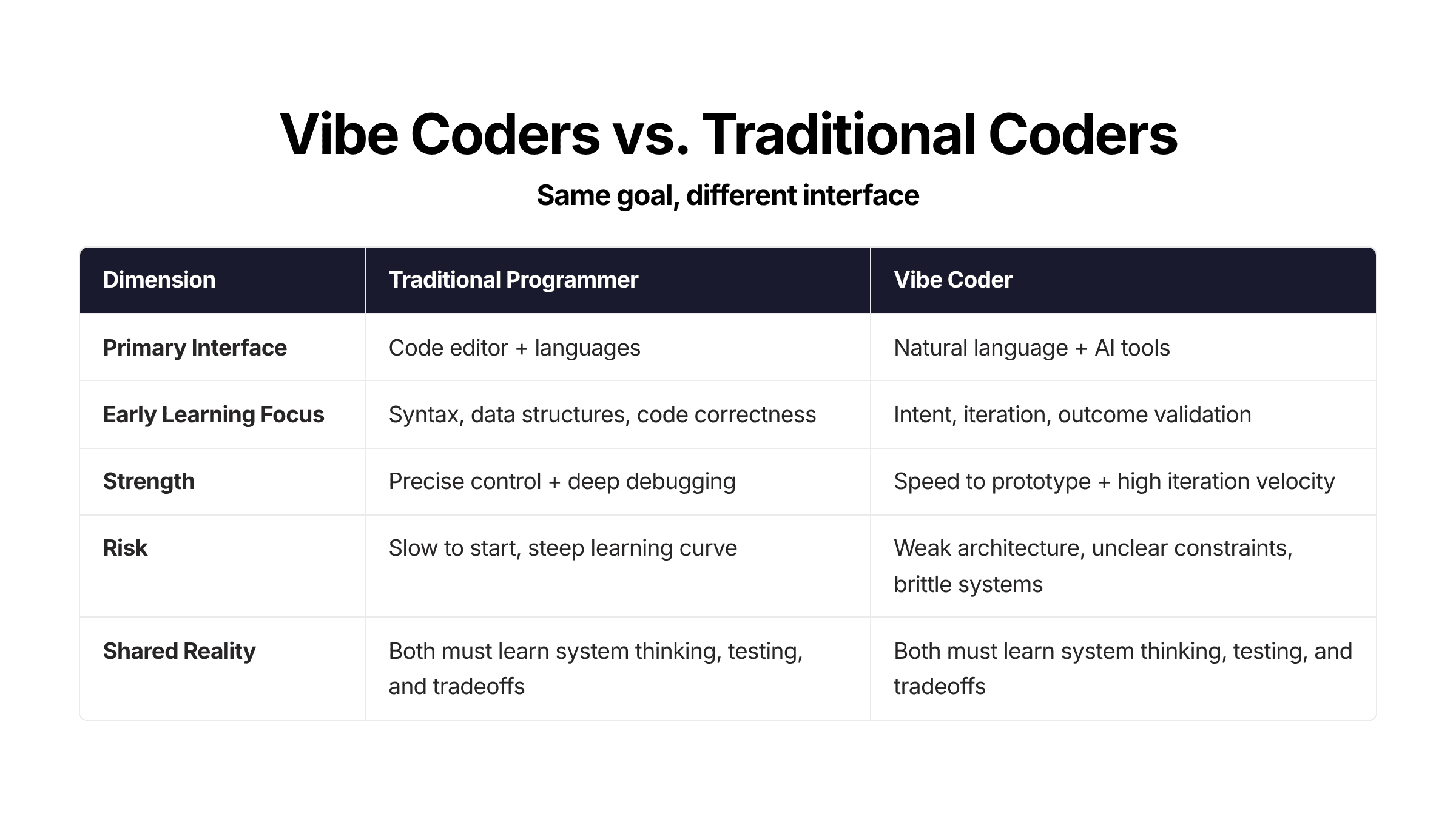
Vibe coders are doing the work of software creation—just through a different interface.
The point isn’t that one replaces the other. The point is that the “supply” of builders is expanding—and that’s exactly what Jevons Paradox predicts when a capability becomes more efficient.
What's the future of software engineering?
It certainly doesn't hurt to know how to code. Every minute of my 25 years of experience in coding remains useful as systems evolve.
But it may not be strictly necessary to know traditional coding to build effective software.
A practical take is:
AI may allow many people to produce valuable software outcomes before they ever learn a traditional language.
In some cases, the lack of a coding background could enable a software engineer to create systems that someone with a coding background wouldn't think of.
If you want to build valuable, durable systems, understanding what’s “under the hood” is still a competitive advantage.
Over time, some will choose to learn coding basics because it increases precision and independence—just like learning to read sheet music helps musicians who started out playing by ear.
What does this mean in the marketplace?
If the Jevons Paradox holds true in software—and the vibe coder wave suggests it is—then the implications are the opposite of the doom narrative for AI.
For developers
Your value shifts from “typing code” toward:
System design.
Judgment in the face of ambiguity.
Translating intent into constraints.
Evaluation, testing, and reliability.
Shaping AI outputs and preventing failure modes.
For companies
You should expect:
More internal software creation.
More experimentation.
More demand for technical leadership.
A broader range of “builders” inside the organization.
The winning path for small businesses and major enterprises alike is to build repeatable ways to:
Turn ideas into reliable systems.
Govern quality.
Teach structured thinking at scale.
For the job market
We'll see more people doing software differently—and the definition of “software engineer” expanding.
Where do I find AI expertise?
The rise of vibe coders is an early indicator that the demand for software work is expanding, not shrinking. The interface is changing, but the underlying need—building systems that work—keeps growing.
That’s why the future may hold more jobs for software engineers, not fewer. But not all of them will look like the ones we’ve been training for the last 25 years.
If you’re exploring how AI changes software delivery—whether you’re a developer, a product leader, or a business trying to build faster—Rellify is focused on the practical side of this transition.
We provide AI solutions based on structured thinking, system-building, and repeatable workflows that turn intent into results. Start your free trial today to see how a robust agentic AI platform can help your business thrive.
About the author
Michael Rollins is a fractional CTO, engineering leader and day-to-day coder. He has deep experience in mobile and backend, and is currently thoroughly enjoying the rocket ship that is AI. You can reach him at michael@rollins.io, or on LinkedIn.


