Rellify vs. Chat-First AI Tools: The Value of Owning Your Agents
Rellify’s agent-first model enables live collaboration, compounding context, and governed workflows—without siloed chats, forked projects, or platform lock-in.

Key takeaways
Chat-first tools share files and prompts; Rellify shares the agent core, so collaboration stays live and doesn’t fork.
When the agent owns the workspace, context compounds into an asset your team can reuse across clients, roles, and time.
Governance matters in agent networks; Rellify emphasizes scoped access, control, and safe orchestration for real business workflows.
By Peter Kraus—AI tools from big-tech vendors are impressive. But companies that invest in them tend to follow a common, frustrating path:
A team buys licenses.
A few power users build great workflows.
Within weeks the work is scattered across individual chats, desktops, and “projects” that don’t quite transfer.
Context drifts.
Knowledge silos form.
The exact thing the companies are trying to scale—repeatable execution—stays trapped in the accounts of individual users. That's what you find with Anthropic's Claude, OpenAI's ChatGPT, Google's Gemini, and others. It happens because they are user-centric and the AI is a capability that drops in to help.
But there's a better way.
Rellify flips the model. The company (client) owns durable agent cores that occupy their own workspace, code, and execution environment. In this model, collaboration stays live, context compounds, and governance is built into the foundations of the system, where it is most effective.
The Rellify architecture flip: The agent is the unit of ownership
Our approach is to treat the agent core, which we call Rex, as the primary unit of work. You get:
A persistent workspace (files and folders).
The code and interfaces the agent creates.
A runtime environment to execute work safely.
The long-lived context that makes the agent better over time.
Why this matters
Most AI tools can share things. Rellify is built for collaboration.
The big-tech AI providers offer project and context sharing. They achieve this by creating a mirrored copy or a shared knowledge base. The agent state is not shared, so changes in one mirrored copy are not reflected in other copies.
Rellify shares the agent itself. This provides a durable, working unit that continues to evolve. The agent preserves a durable state, so you can:
Collaborate in the same agent (not “send a copy”).
Share an agent with a teammate so both of you see the same updates.
Reuse successful setups as templates (critical for teams and consultants).
Scale to agent networks without every handoff resulting in a context loss.
Agentic AI collaboration vs. sharing
For a useful analogy, compare the old method of “sharing” documents that Microsoft Word once provided through track changes. You mailed a document to one or more people, and this resulted in multiple versions being created—each containing different information.
Google created a different approach. It made one document accessible to multiple users who could collaborate there.
In the chat-first tools that big-tech systems provide, the user owns the workspace, just like each person who called up that Word doc owned that version of the document. This means:
The user account is the container of truth.
“Projects” or “shared contexts” are add-ons.
Collaboration tends to mean sharing a project knowledge base, not sharing the living state of an agent that’s doing work.
The result is:
You can share outputs.
You can sometimes share a project.
Collaboration often results in forking and the need to reconcile multiple versions of the results.
But you typically don’t share:
Individual chat histories within a project.
The evolving work-in-progress state.
Agent memory and compounding institutional learning.
In Rellify, the user spins up an agent core. A Rex agent core includes chats, multi-agent chats, a runtime/execution environment, a document/workspace layer, smart cards, a blueprint library, and templating. The agent is a repeatable unit you can share and operationalize.
Rellify is agent-first with multi-user access with a company:
The company or users own the agent, or agents.
Each agent runs in its own secure runtime environment.
Teams operate on the same durable “artifact.”
Improvements persist for everyone who uses it.
Practical differences you’ll feel in week one
These are not theoretical niceties. You can tell the difference, and feel the power of Rellify’s approach, right away. Here are some of some of the ways agent-centric AI can solve problems and allay fears.
1) You own a working AI “computer,” not just a chat window
With Rellify, the AI agent comes with its own workspace where work actually lives (files, instructions, history, outputs).
Why it matters: Your AI doesn’t “reset” every time you switch devices or teammates, or as time passes. The work stays organized in one place and remains usable over time. You’ll have:
Fewer broken handoffs.
Clearer responsibility boundaries.
Lower overhead from the need to “explain everything again.”
2) You can collaborate in the same AI agent (not send copies back and forth)
Instead of “sharing” something like a document or a chat transcript, you can share the agent itself so multiple people are working with the same setup.
Let's say, for example, a company is using Rex and has created an AI agent for its marketing team. Instead of each marketer having their own siloed assistant, the team can use a shared agent core for:
Campaigns.
Content operations.
Competitive research.
Reporting … so the agent’s context becomes a shared asset.
Why it matters: You avoid the “version mess” where everyone has a slightly different copy of the workflow, and nobody knows which one is current.
3) Your company’s knowledge builds up over time instead of getting scattered
The agent becomes a place where your best processes, decisions, and context accumulate—like a living “company brain” for a specific function (marketing, ops, sales, etc.) and for the overall business.
Why it matters: The value doesn’t stay stuck in one person’s head (or one person’s chat history). If someone leaves, the knowledge and process don’t leave with them. The enterprise value of company knowledge—an important asset—compounds over time.
4) You’re not locked into one AI vendor’s universe
Rellify is designed so your agent system can work across different AI models and environments. Choose different models for different tasks—selecting from multiple versions of ChatGPT, Claude, and Gemini.
Why it matters: You’re not forced into one provider’s pricing, limitations, or future roadmap. You keep leverage—and flexibility, which is important in the fast-changing world of AI.
5) It’s meant to run real business workflows, not just answer questions
Rellify is built around repeatable workflows (blueprints, structured workspaces, reusable setups), not just “type in a prompt and hope for a good answer.”
Why it matters: You can turn AI into something operational—faster onboarding, consistent outputs. You avoid one-off experiments that don’t scale.
6) There’s a clear, low-risk way to roll it out
Instead of “buy licenses and figure it out,” Rellify supports a practical rollout path:
Audit your processes and determine what’s safe and valuable to automate.
Deploy a first company agent that delivers value quickly.
Enable the team, so adoption sticks.
Why it matters: You reduce the chance of ending up with “AI shelfware”—AI tools you pay for but don’t use—and increase the chance that you’ll get measurable results.
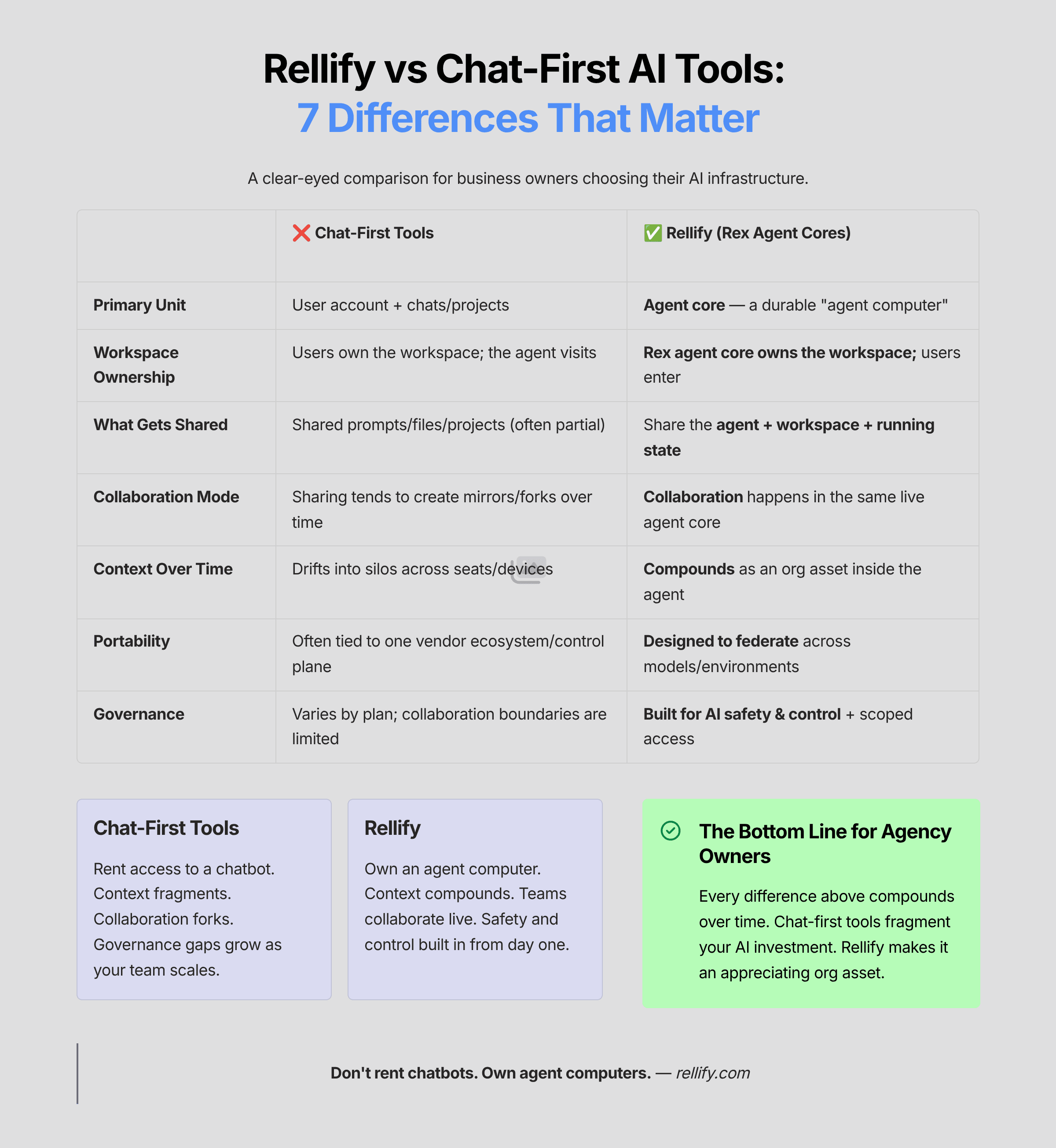
What does it mean for the “agent to own the workspace”?
When the agent core owns the workspace, three things happen that are hard to replicate with chat-first architectures:
Context compounds instead of fragmenting into silos
In a user-centric model, teams accumulate “knowledge silos” because context lives per-user, per-seat, or per-desktop.
In an agent-centric model, each interaction enriches the shared agent context layer.
Collaboration becomes live, not mirrored
You aren’t handing someone a copy of “how you did it.”
You’re letting them step into the same agent core that does it.
Continuity survives role changes
When a person leaves, the system doesn’t lose its operational memory.
AI governance is hard
Rellify is built with safety and control as a default, not an afterthought. We know AI can make mistakes, so it needs guardrails around what it can access and do.
The latest example is the case in which a mix of Claude Opus 4.6 and the Cursor coding agent deleted a company’s production database — and its backups — in seconds.
When you move from single-user assistants to multi-agent networks, you inherit real security and governance problems:
What can this agent access?
What can it change?
Which other agents can it ask for help?
How do you prevent lateral movement across tools and permissions?
Rellify’s architecture provides scoped boundaries from request → identity/permissions → orchestration → execution services → data planes → external providers.
Our built-in guardrails lower risk when you start using AI for real business work (not just drafting text). You can feel confident about using AI with meaningful internal context.
FAQ
1) How is Rellify different from ChatGPT, Claude Projects, or Gemini Workspace?
Most chat-first tools center on the user account and share project context in limited ways. Rellify centers on a durable agent core that owns a workspace and keeps state. That changes how teams collaborate: instead of copying workflows or losing history across seats, your shared agent keeps improving in one place.
2) Do I have to stop using my current AI tools to use Rellify?
No. Rellify is designed to sit above models and tools, not replace everything overnight. Many teams keep using chat tools for quick drafting while moving repeatable workflows, shared context, and governed execution into Rellify. The goal is operational continuity and collaboration, not forcing a single tool choice.
3) What does “own the workspace” actually mean for a business team?
It means the agent’s working environment holds the files, instructions, outputs, and evolving state of work in a persistent place the team can enter. Instead of each person having their own private chat history, the team operates inside a shared “agent computer.” That makes handoffs cleaner and results easier to repeat.
4) Why does governance matter if the AI is “just helping with marketing”?
As soon as AI touches real systems—analytics, CRM, docs, email, or scheduling—mistakes become costly. In multi-agent setups, one agent can accidentally trigger actions through another tool if boundaries aren’t clear. Governance is what lets you scale beyond experiments: scoped access, controlled actions, and visibility into what happened and why.
Rellify vs. chat-first AI – Lead the transformation
If you’re evaluating AI agents from big-tech vendors, notice that they give you an assistant that works inside your account. They are centered around user accounts. Rellify gives you a durable, shareable agent “computer” that owns its workspace, code, and execution environment.
Rellify’s approach to agentic AI enables teams to collaborate in the same agent. Context compounds instead of forking.
Start with one Rex agent core running one agent app. Recognize the value quickly. Scale to a network you own that’s powering your organization forward.
If you’re already using Claude, Gemini, or OpenAI, you don’t need to rip anything out. The practical question is: Do you want to rent chat and projects—or own an agent layer that persists, collaborates, and compounds?
Start your free trial today. Or, if you prefer, we can give you a live demo.
About the Author
Peter Kraus, CEO of Rellify, is a seasoned architect of innovative business solutions that deliver significant value to clients and shareholders. In 1997, he founded a telecommunications real estate development company, achieving a remarkable 13:1 ROI by selling assets to a REIT within two years. He later joined a software start-up in 2000, pioneering the integrated travel and expense SaaS product and forging exclusive strategic partnerships for what became the Concur enterprise platform. With extensive experience in M&A activities and global supplier management, Peter negotiated and implemented industry-first solutions and led teams that launched e-receipt services and Concur Pay, processing over $40 million per month within the first year.
Peter's background in software development brings a balanced and intuitive approach to Rellify. His experience with global software solutions, including Concur's journey from start-up to its $8.3 billion exit to SAP, gives him exceptional insight into positioning Rellify for major growth opportunities. His visionary leadership motivates our global team as we bring the Rellify platform to life.
About the author

Peter Kraus
Chief Executive Officer
Peter Kraus is a seasoned architect of innovative business solutions that deliver significant value to clients and shareholders. In 1997, he founded a telecommunications real estate development company, achieving a remarkable 13:1 ROI by selling assets to a REIT within two years. He later joined a software start-up in 2000, pioneering the integrated travel and expense SaaS product and forging exclusive strategic partnerships for what became the Concur enterprise platform. With extensive experience in M&A activities and global supplier management, Peter negotiated and implemented industry-first solutions and led teams that launched e-receipt services and Concur Pay, processing over $40 million per month within the first year.
Peter's background in software development brings a balanced and intuitive approach to Rellify. His experience with global software solutions, including Concur's journey from start-up to its $8.3 billion exit to SAP, gives him exceptional insight into positioning Rellify for major growth opportunities. His visionary leadership motivates our global team as we bring the Rellify platform to life.


